
11/2/2018:
“Around 93% of the world’s children under 15 years of age breathe air that is so polluted it puts their health and development at serious risk, accounting for 1.8 billion children”(McDougall, 2018).
Read that statistic again.
Ninety-three percent of the entire world’s children. Ninety-three percent! That is nearly every single child on Earth. Let’s not forget that the ultimate cause behind this massive threat is our own people. Consider this; human conscious efforts are responsible for diminishing the health and life span of almost every existing child, our future generation.
I was walking to class when the headline: “More than 90% of world’s children breathe toxic air, report says, as India prepares for the most polluted season” from a CNN notification popped up on my phone screen. I immediately thought: ‘wow has it really become this bad?’ , which is exactly why I am writing this post. Even after studying AP Environmental Science and staying updated with most global news, this statistic still left me surprised. I would predict that the majority of people in industrialized nations fail to recognize the extent to which their actions are impacting the livelihood of our Earth.
The World Health Organization (WHO) dedicates many resources toward informing and combatting this global dilemma. They gather data on emission levels, various gas concentrations, particulate matter presence, along with correlated respiratory illness and other adverse health condition incidence rates. The findings are discussed and presented at major conferences, specifically this year’s first WHO Global Conference on Air Pollution held in Geneva, Switzerland just a couple of days ago. In collaboration with other United Nations organizations, they strategize tactics toward limiting future air pollution and setting guidelines. (“Air”, 2018)
The WHO website publicizes:
- “Ambient air pollution accounts for an estimated 4.2 million deaths per year due to stroke, heart disease, lung cancer and chronic respiratory diseases.”
- “Around 91% of the world’s population lives in places where air quality levels exceed WHO limits.” (“Air”, 2018)
Ambient air is essentially the atmospheric, outdoor air we breathe. The heavily monitored and harmful pollutants in the ambient air include particulate matter, sulfur dioxide, nitrogen dioxide, and ozone. Household air pollution due to certain cooking fuels also poses major health threats (“Air” 2018).
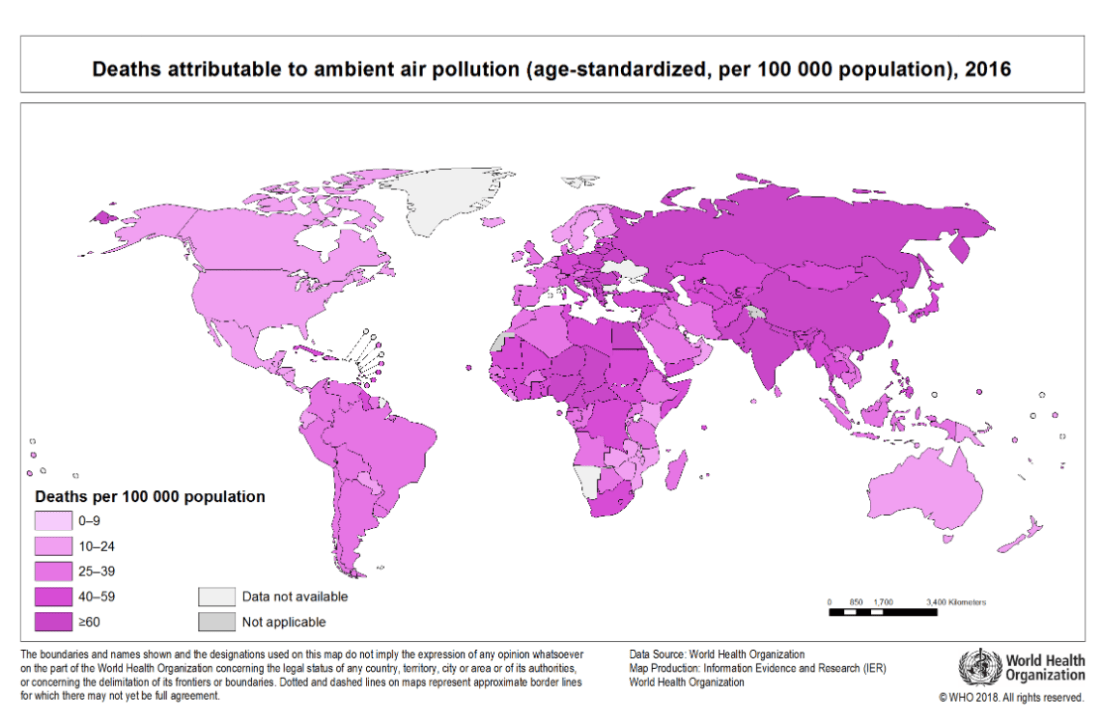
To learn more about global air pollution data and guidelines, visit:
http://www.who.int/airpollution/ambient/en/
Suggested country-specific readings:
Air Pollution Impacts on Health and Health Expenditures in China:
https://www-sciencedirect-com.libproxy.clemson.edu/science/article/pii/S0959652616300312#sec4
Canada making positive changes toward improving urban air quality:
https://www.sciencedirect.com/science/article/pii/S1618866717302182#sec0050
Sources:
“Air Pollution”. World Health Organization. 2018.
McDougall, M.“More than than 90% of world’s children breathe toxic air, report says, as India prepares for most polluted season.” CNN. October 29, 2018.
 Keeping Up with Global Health